Wait for our Next Sale - up to 50% OFF!

Why Office Fragrances Don’t Last — And How Molecular Design Fixes It

Office fragrances often fail for one simple reason: they’re designed for impact, not endurance.
In office environments, projection becomes a problem long before longevity does. Fragrances that last tend to feel too loud. Fragrances that feel appropriate disappear by mid-morning.
Most people blame concentration for this — assuming higher percentages automatically last longer. In practice, that assumption is wrong. What actually determines how long an office fragrance lasts is molecular structure, material selection, and how a formula is layered over time. This article breaks down why office fragrances behave the way they do — and how intelligent molecular design solves the problem.
Why Office Fragrances Fail to Last
I spent years assuming concentration was the solution. Bigger numbers had to mean better performance. If something faded too quickly, the answer must be more oil, higher percentage, stronger concentration.
I chased 20%. Then 25%.
It didn’t fix the problem.
What it showed me instead was this: longevity isn’t dictated by numbers on a label. It’s dictated by what the fragrance is actually built from, and how those materials behave over time.
A moderately concentrated fragrance with a properly designed base will consistently outlast a high-percentage fragrance with weak structure. I’ve seen this play out repeatedly, both in formulation and on skin.
People buy based on the percentage. They spray generously. It smells great at 9 AM. By lunch, it’s gone. Or they overshoot in the other direction and end up wearing something that’s still pushing hard at 3 PM, drawing attention in meetings for all the wrong reasons.
Neither outcome works in an office setting.
So what actually makes the difference?
The fresh fragrance problem
Fresh fragrances are the hardest category to make work for office wear. Citrus, aquatic, herbal profiles — bergamot, mandarin, ozonic notes, airy greens. They’re immediately appealing. They feel clean, bright, energetic.
And then they disappear.
Sometimes within minutes. Sometimes within an hour. Either way, the drop-off is fast.
This isn’t mysterious. Citrus and many fresh-smelling molecules are volatile by nature. They evaporate quickly. That volatility is exactly what makes them smell vibrant and alive at first application.
The trade-off is longevity.
Your nose gets hit immediately, which feels satisfying, but the structure underneath hasn’t had time to establish itself yet.
The real frustration shows up afterward.
Once the top notes burn off, what’s left? If the base hasn’t been designed carefully, there’s a gap. The fragrance doesn’t taper or evolve — it just falls silent.
You’ve probably experienced this without thinking about it. Someone around mid-morning says, “What smelled good earlier?” And that’s when you realise it’s already gone.
That sudden absence is what people describe as poor longevity.
This is why fresh fragrances get a reputation for not lasting.
People assume that if something opens strong, it should naturally last longer. But without a solid foundation underneath, you’re essentially watching the most volatile part of the formula evaporate and take the whole experience with it.
The fix isn’t adding more fragrance.
And it isn’t jumping to a higher concentration.
The fix lives underneath the freshness.
How molecules actually behave on skin
I’ll keep this practical.
Not all fragrance molecules behave the same way once they hit skin. Some are light and airborne. Others are heavier and more persistent. Some disappear quickly. Others sit close to the skin for hours.
This isn’t complicated science. But it’s the difference between something that works and something that doesn’t.
Heavier molecules tend to evaporate more slowly. Materials with higher boiling points usually stay closer to the skin. Molecules with strong affinity for skin lipids don’t rush off into the air — they settle in and hang around.
They stay until your skin chemistry decides otherwise.
When I’m formulating, this question is always running quietly in the background: what leaves first, what stays, and what comes forward next?
Longevity isn’t about piling heavy materials into a formula and hoping for the best. That approach just creates flat, muddy fragrances. It’s about choosing the right materials and arranging them so they surface gradually.
Longevity is about sequencing, not weight alone.
Here’s the distinction most people miss:
Concentration controls how strong a fragrance smells in the moment.
Molecular selection controls how long it stays.
These two things are not interchangeable.
You can wear a 25% fragrance that disappears by mid-afternoon. Or a 15% fragrance that’s still quietly present at 5 PM. For office wear, the second one actually does what it’s supposed to do.
What we actually do at Bois et Fleurs Parfums
Let me make this concrete.
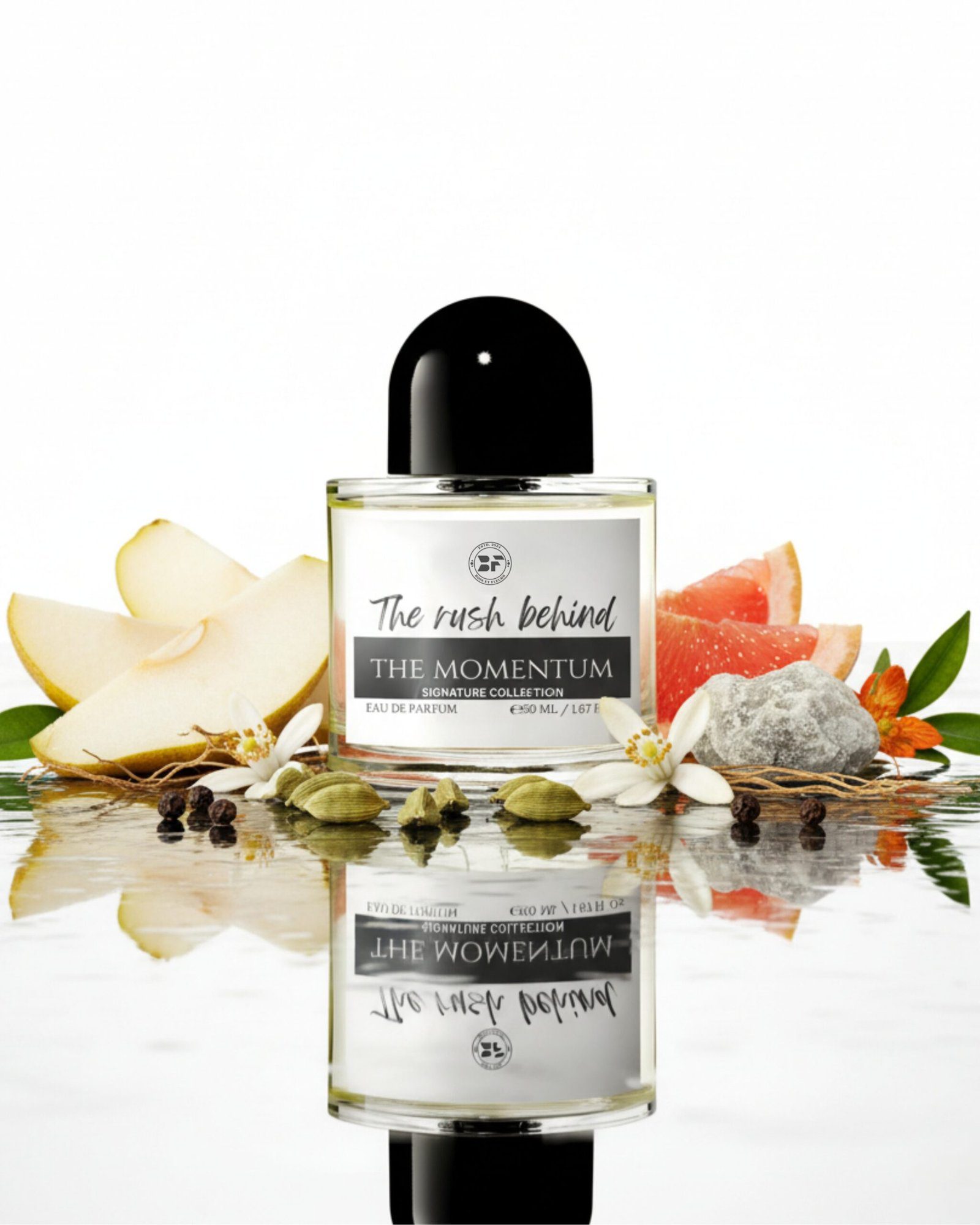
The Momentum
The opening is intentionally fresh — pear, grapefruit, cardamom. I know those notes won’t last more than a couple of hours. That’s expected, not a flaw.
The real work happens in the base.
Ambergris (or a solid synthetic equivalent), gaiac wood, vetiver oil, and carefully selected musks each play a role. As the citrus fades, the woods rise. As the woods soften, the musks hold the structure together.
It isn’t one ingredient doing all the work. It’s a sequence.
Later in the day, the question becomes: “Is that still The Momentum?”
Not: “Did something smell nice earlier?”
Forgotten Letter
This one needed a different solution.
The lemon and lavender opening is bright but fleeting. To avoid a mid-day collapse, it needed a bridge rather than a blunt anchor. Tobacco absolute fills that role well.
The progression is intentional. Lemon fades first. Tobacco and sage take over for a few hours. Then amber and patchouli settle in and carry the fragrance through the rest of the day.
You don’t experience a fade-out.
You experience movement.
Endless Ocean
Aquatic fragrances come with a built-in problem. The molecules that make them feel watery and fresh are, by nature, volatile. Water doesn’t cling — and neither do most aquatic materials.
Instead of fighting that reality, the structure is designed around it.
The opening behaves like an aquatic should — bright, clean, ozonic, fleeting. But the base relies on amber accords, aromatic profile and musks. Materials that don’t announce themselves, but don’t vanish either.
At 5 PM, it still smells fresh. Quietly present. Not loud — but not gone.
Solar Wind
Yes, this one is an extrait. Higher oil concentration. lasts the least among 3 discussed.
Ambroxan was engineered for longevity. High boiling point. Strong skin affinity. Low aggression. It doesn’t project loudly — it stays close.
The citrus and ginger open quickly. The heart holds for a couple of hours. Then ambroxan and javanol carry the structure well further..
Concentration doesn’t mean what people think it means
This will sound bold, but it’s based on repeated testing:
A 15% fragrance with intelligent base architecture will outlast a 25% fragrance with weak structure.
Every time.
Concentration tells you how intense something smells at a given moment. Longevity depends on molecular behaviour — evaporation rate, skin affinity, and how materials are layered.
In office environments, volume isn’t the goal.
Persistence is.
The myths that refuse to die
“Higher percentage always lasts longer.”
It doesn’t. Weak structure just means louder evaporation.
“Fresh fragrances can’t last a full workday.”
They can, if the base is designed properly.
“Just add more fixatives.”
Fixatives help, but overuse flattens a fragrance. Longevity should be designed, not patched.
“Naturals always outperform synthetics.”
Some naturals last well. Modern synthetics exist specifically to extend wear and consistency.
“Longevity is the same for everyone.”
It never is. Skin chemistry changes everything.
Choosing an office fragrance intelligently
Ignore the percentage first. Look at the base. What woods are present? What musks? How is the amber built? Good office fragrances don’t announce you when you enter a room. But they’re still there when the day ends.
That isn’t accidental.
That’s design.
Final thought
Wear a fragrance through a full workday before judging it. Pay attention to when it shifts. Notice how it settles.
The goal isn’t smelling impressive at 9 AM.
It’s smelling intentional at 5 PM.
References
- International Journal of Cosmetic Science
https://onlinelibrary.wiley.com/journal/14680238 - International Fragrance Association (IFRA)
https://www.ifraorg.org/ - Cosmetics and Toiletries Magazine
https://www.cosmeticsandtoiletries.com/ - Fragrance Chemistry – Volatility and Boiling Points
https://www.fragrancebuy.com/pages/fragrance-chemistry - Synthetic Musks (Polycyclic Musks and Ambroxan)
https://en.wikipedia.org/wiki/Musk_(fragrance) - Cedarwood Chemistry
https://www.ncbi.nlm.nih.gov/pmc/articles/PMC5623121/ - Sandalwood Oil Chemistry
https://www.ncbi.nlm.nih.gov/pmc/articles/PMC3679457/ - Vetiver Oil Properties
https://en.wikipedia.org/wiki/Vetiver - Patchouli Oil Components
https://www.ncbi.nlm.nih.gov/pmc/articles/PMC5003755/ - Fragrance Longevity and Skin Chemistry
https://www.researchgate.net/publication/257819890_Evaluation_of_the_Impact_of_Consumer_Lifestyle_on_the_Longevity_of_Fragrance_Products - Molecular Weight and Evaporation
https://www.britannica.com/science/volatility
Disclaimer
This article is intended for educational purposes only and reflects our experience and research at the time of writing. Perfumery is subjective and continuously evolving. Readers are encouraged to conduct their own research and form independent conclusions.